
Our vision
Every government, easy to see and easy to reach.
Our goal is government transparency, leading to better trust between the public and its government. We get there by making every government easy for the people it serves to see, reach, and understand: anywhere in the world, in any language, through one consistent interface.
Why UnGovr exists
Transparency first. Trust follows.
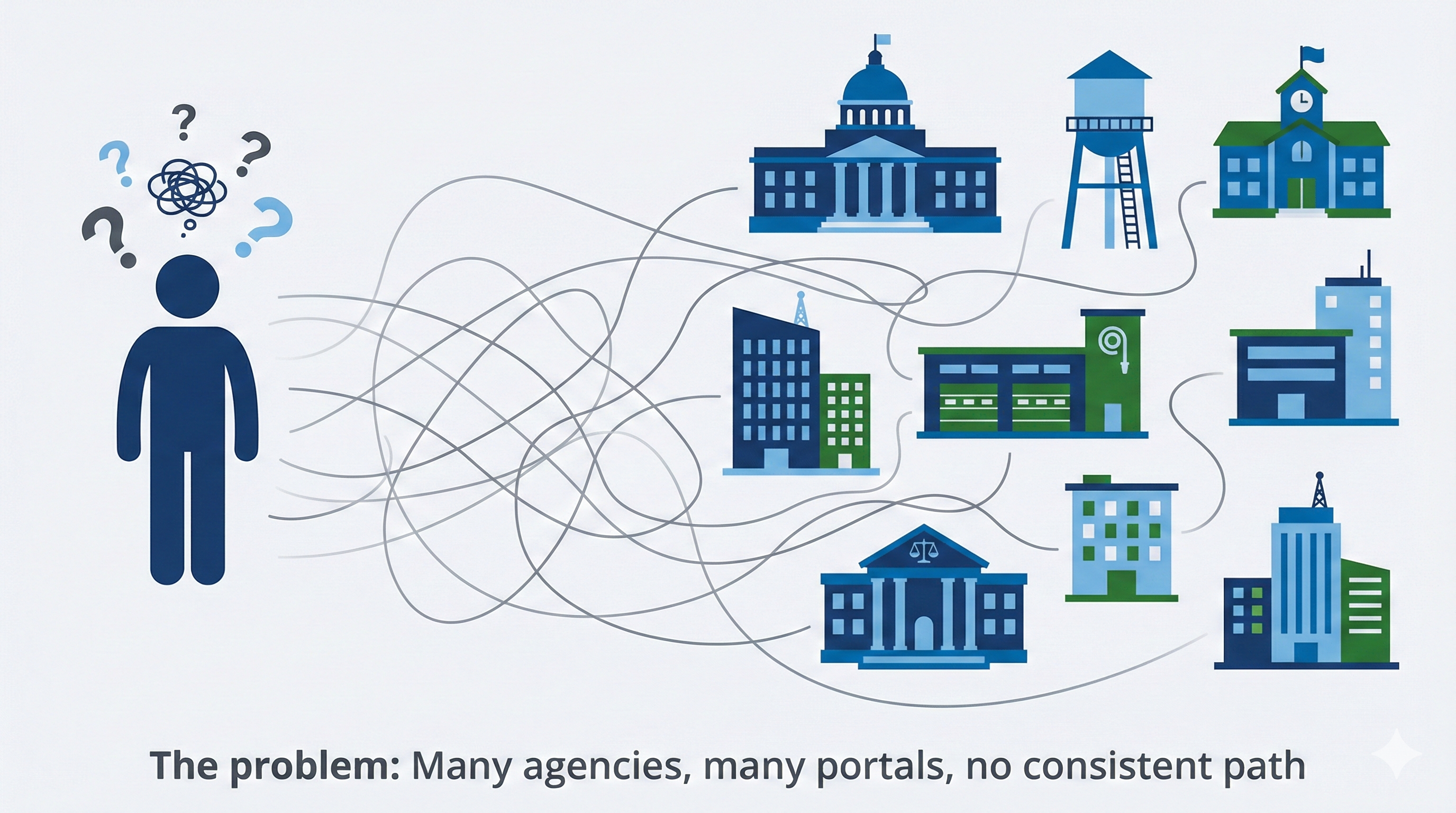
Today, friction runs in both directions. Residents struggle to find the right agency, navigate incompatible websites, and piece together context from scattered sources. Governments struggle to make services discoverable, answer records requests, and reach the people they serve. That two-sided friction erodes trust, and closing it, jurisdiction by jurisdiction, is the work of the years ahead.
When the friction closes, three things follow: a better educated public, because understanding government no longer requires insider knowledge; a more efficient government, because requests arrive at the right agency in the right form; and communities whose governance better reflects their own values, because the people who live under an institution can finally see it and reach it. We treat these as outcomes of transparency, not campaigns of our own. The thesis lives in making government visible and reachable, never in advocating any particular policy result.
The bridge
One layer, three parts, both directions.
Government works in two directions: information and services flow out to the public, and requests and participation flow in from residents. Today, both directions are broken by complexity: thousands of agencies, each with different systems, procedures, and requirements.
UnGovr is a bridge layer that simplifies both directions, and it is built from three things. Identity: which bodies exist, what each one is, and what it is responsible for. Geography: the territory each one actually governs, so a location resolves to the stack of bodies over it rather than to a mailing address. Routing: the path from a person or a system to the specific office that owns the matter, in the form that office accepts.
Those three are what make either direction work. Outward: open records, meeting documents, service updates, and public notices become findable and understandable in one place, attached to the body they came from. Inward: service requests, open records requests, and public comments reach the right agency in the right format, without residents needing to know the internal structure.
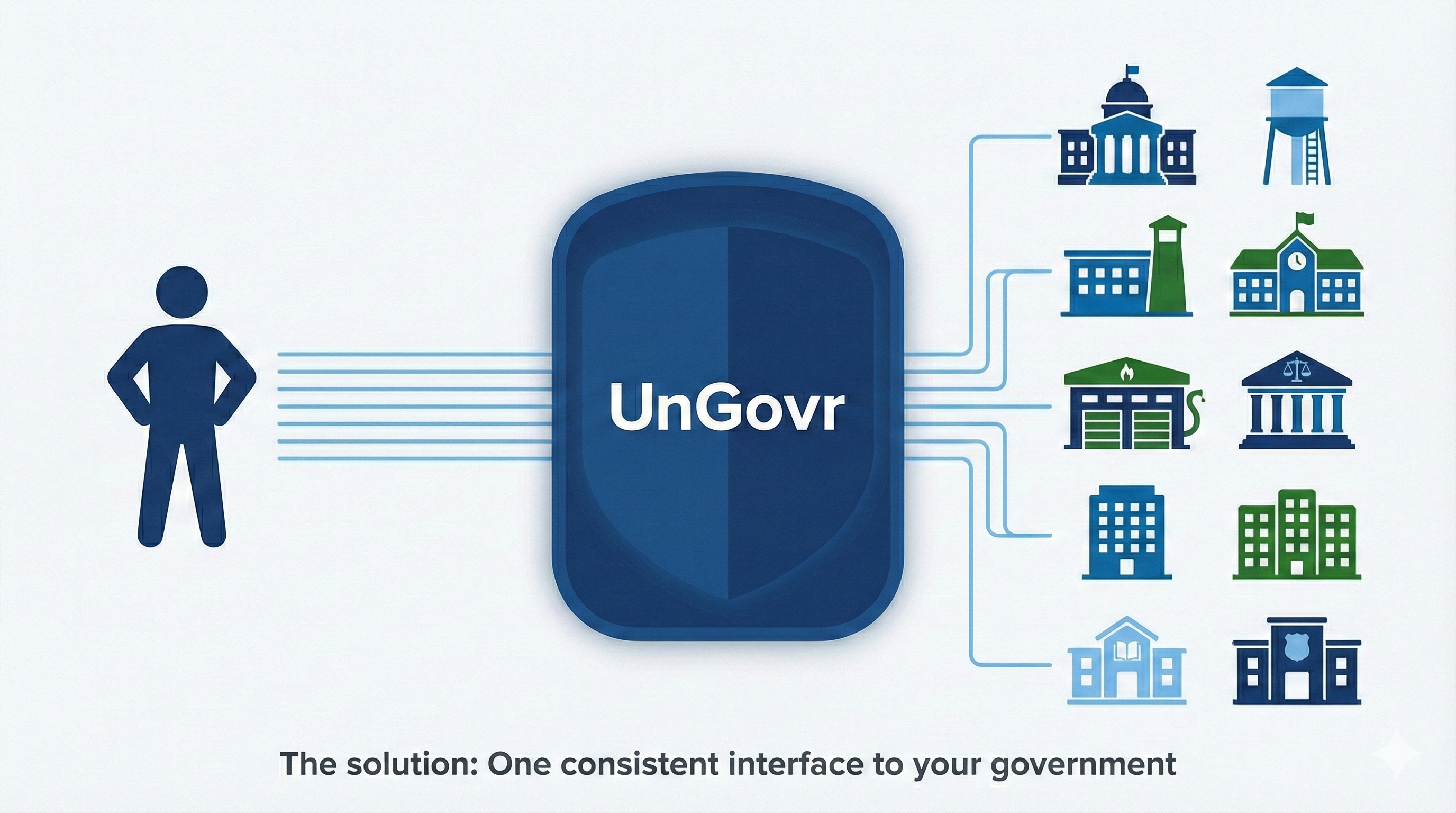
Critically, UnGovr does not require any software to be installed within government. We work with what already exists (public websites, existing email addresses, standard open-records procedures, published meeting calendars) and build the bridge from the outside. Any jurisdiction, anywhere in the world, can benefit without procurement, IT approval, or integration projects.
Where this stands
The bridge is already carrying traffic.
None of the above is a proposal. Identity and geography are built: UnGovr Atlas maps 330,000+ government entities across 200+ countries, with 170,000+ boundaries drawn on the ground. Authority and record are published: Law indexes 398 open records laws across 140+ countries, Monitors documents government power and its controls across six public monitors, and Grand Jury Reports makes 12,000+ California civil grand jury reports searchable in one place. Routing is the newest of the three and the one still widening: Request delivers a resident's report to the agency that actually owns it, in pilot across California and Ireland.
Each is the same bridge pointed in a different direction, and each one makes the next jurisdiction cheaper to reach than the last. That is the scalable structure below, working: the full list, including what is still being built, is on the about page.
Principles
The rules the work follows.
Traceable sources
Information in UnGovr is meant to link back to its original source. We do not replace official records; we make them easier to find and understand.
Privacy by design
We collect the minimum information needed to provide value. We do not sell personal data or create profiles for advertising purposes.
Accessibility
Government information belongs to everyone. We design for diverse users, including those who may have limited time, technical skills, or familiarity with government processes.
Neutrality
UnGovr is a tool for civic engagement, not an advocate for particular outcomes. We surface information and opportunities to participate without taking positions on policy.
Scalable structure
We start focused, build repeatable patterns, and expand. Rather than trying to cover every jurisdiction immediately, we develop approaches that can grow over time.
What success looks like
Working, in both directions, for everyone.
For residents
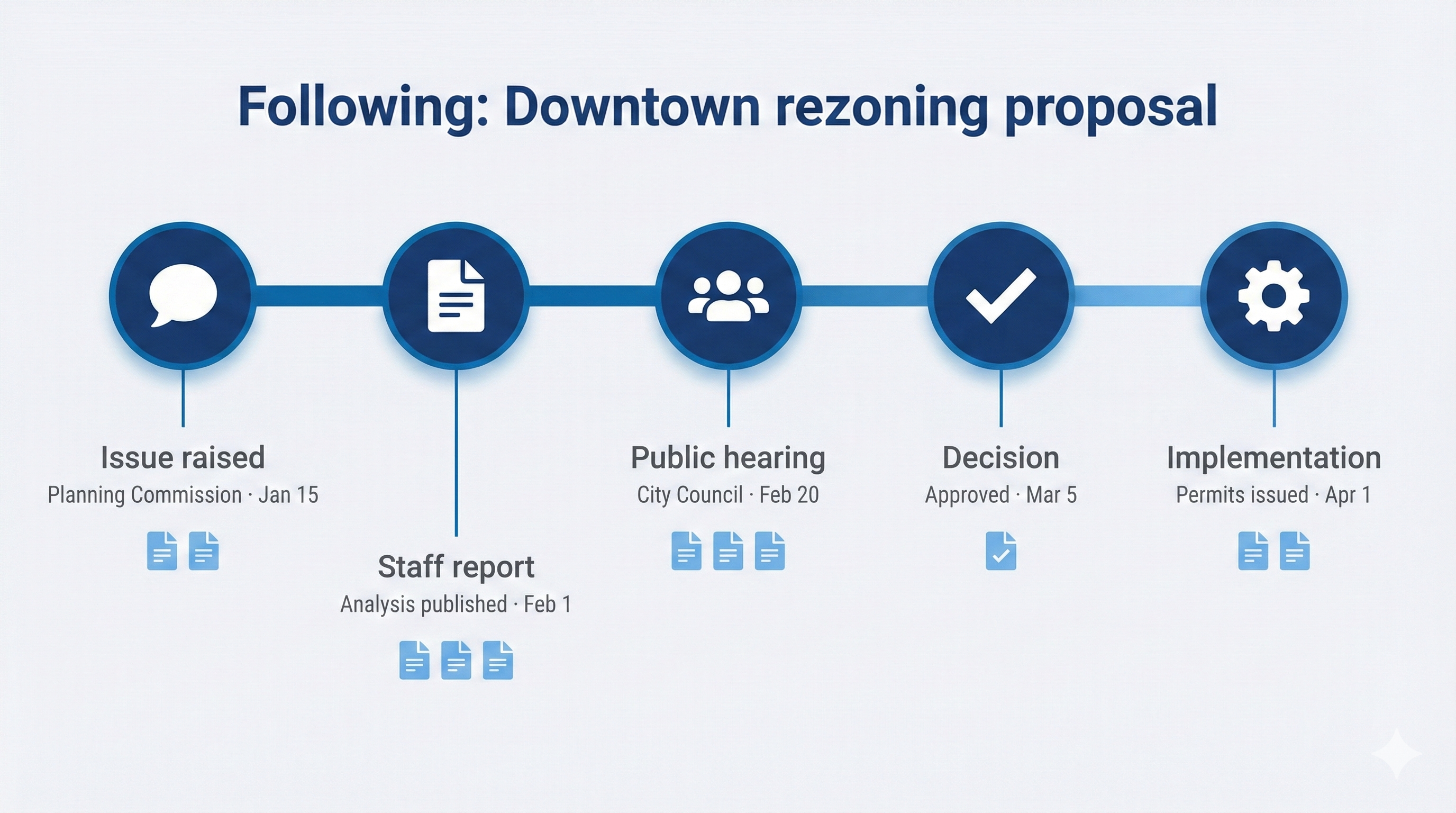
Finding the right agency for your issue no longer requires insider knowledge. Filing an open records request no longer requires a law degree; UnGovr handles the complexity of different laws, deadlines, and procedures across jurisdictions. Following an issue across meetings and documents no longer takes detective work.
For government
Requests arrive properly formatted and directed to the right department. Staff spend less time on routing and process, and more time on substance. Open records and public notices reach a wider audience without additional publishing effort. The tools that make this possible are developed once and work everywhere: a small town benefits from the same infrastructure as a large city.
For agents
Any software that interacts with government, from civic apps and dashboards to agentic AI systems acting on behalf of residents, can query entities, boundaries, services, laws, and records programmatically. The same data that powers our consumer experience is available through structured APIs with consistent shape across jurisdictions, so tools can navigate government as fluently as a well-informed person.
For trust
When interactions between people and government work well in both directions, trust grows. Residents who can see what their government is doing and get timely responses to requests are more likely to engage. Government that can serve the public efficiently earns the credibility to govern effectively. Over time, this creates a cycle where better access leads to more participation, which leads to better governance. That cycle is the point of the whole platform, the map included.
Boundaries
What UnGovr is not.
- Not a government agency. UnGovr is an independent nonprofit organization. We don't make decisions or take official action on behalf of any government.
- Not legal advice. Information on UnGovr is for general purposes and should not be treated as legal counsel.
- Not a replacement for official sources. UnGovr helps you find and understand official records, but the official sources remain authoritative.
- Not built to monetize personal data. We operate as a nonprofit and don't sell user information or display targeted advertising.
Why now
The tools finally exist.
Several developments make this possible today in ways that weren't feasible before:
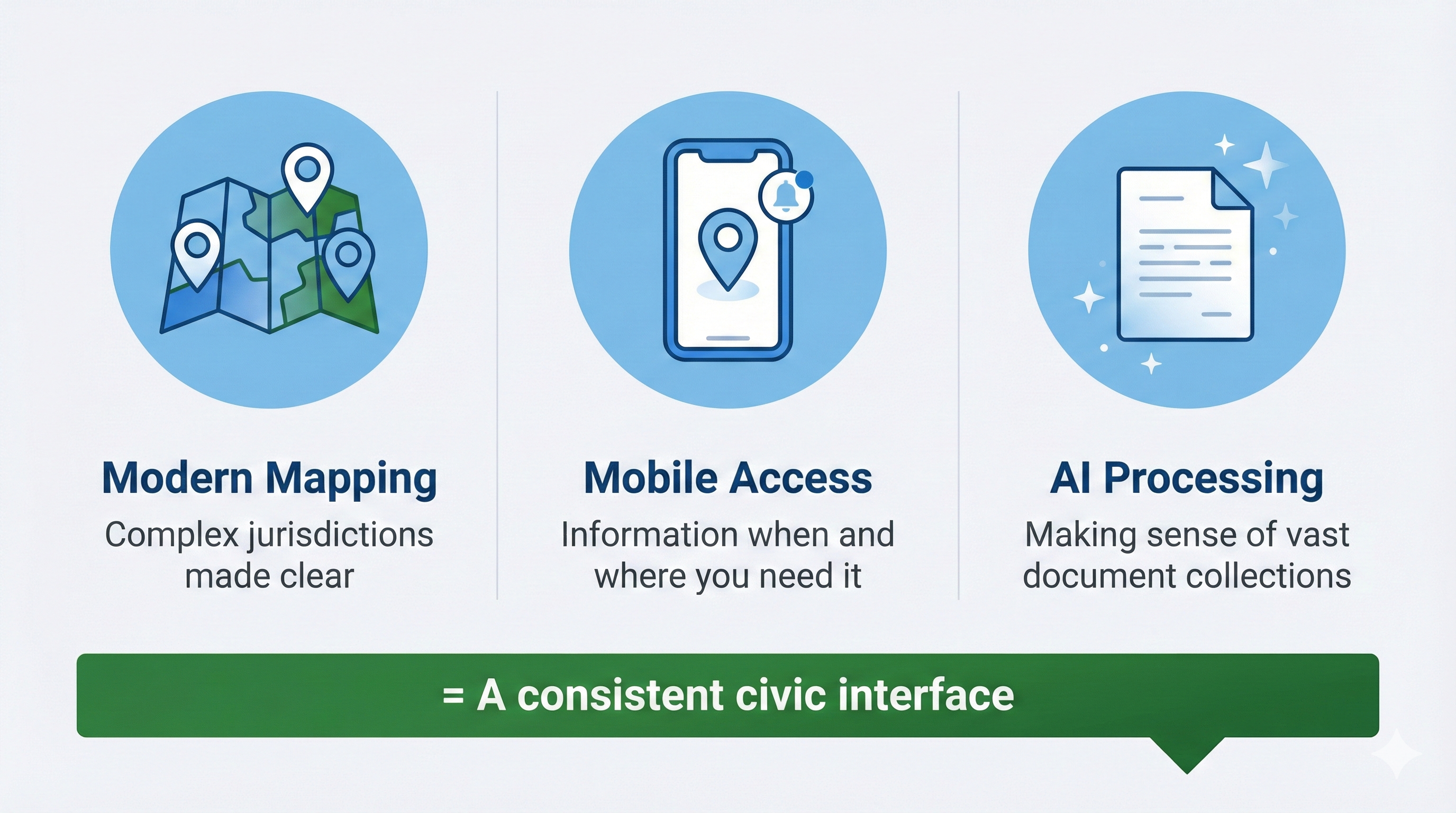
- Modern mapping. Geographic data and tools have become sophisticated enough to accurately map the complex overlapping jurisdictions of local government.
- Mobile-first access. Most people now have capable devices in their pockets, enabling location-aware experiences and notifications.
- AI capabilities. Language models can process, summarize, and connect information across large document collections, and across languages, in ways that would require enormous manual effort otherwise.
- Centralized tooling, universal reach. A single set of civic tools, developed centrally, can serve government tasks in very different places. The same platform that helps a California city respond to records requests can help a commune in France, a municipality in Ireland, or a prefecture in Japan, because the work happens outside government systems, not inside them.
Because UnGovr requires no software installed within government, adoption is not gated by procurement cycles or IT budgets. The bridge works from the outside, using public interfaces that already exist. This means the tooling can scale to new jurisdictions and countries without waiting for each government to opt in.
Questions
Frequently asked questions.
What "your government" means
"Your government" refers to the various entities that affect your daily life based on where you live and work. This typically includes your city or town, county, school district, water district, and other special districts, as well as state and federal agencies that serve your area.
We're already working across 200+ countries (all 50 US states, Canada, 48 European countries including France, Germany, Spain, Italy, Ireland, and the UK, plus Japan, South Korea, Australia, and dozens more across Africa, Asia, and the Americas) with the same core platform. Because UnGovr works from the outside, without requiring government to install anything, the patterns we build are inherently portable across different governance structures worldwide.
Government works in two directions, and both are tangled by complexity. Public information is scattered across agency websites and buried in meeting minutes. Sending a request (for records, services, or public comment) means figuring out the right agency, the right format, and the right law. Mapping government means giving each body an identity, and, where boundary data exists for it, the territory it serves, so both directions work: information flowing out to people, and requests flowing in to government, without the friction.
Participation
UnGovr helps by providing context: surfacing relevant background on issues, showing how topics have been discussed over time, and alerting people to upcoming opportunities to engage. We don't take positions on issues, but we try to lower the barrier to informed participation.
Yes. We're building features to surface upcoming public meetings, provide context about what's on the agenda, and help people understand how discussions connect to previous decisions. Our goal is to make it easier to stay informed without having to track multiple agency calendars.
Yes. We're building tools that let users file FOIA, open records, and freedom of information requests directly. Open records laws vary enormously: across 140+ countries and 57 US jurisdictions there are different response deadlines (3 to 30+ days), residency requirements, fee structures, and appeal processes. UnGovr navigates this complexity for you, identifying the correct law and agency and helping you submit a properly formatted request. Responses are processed into Open Records Extracts (OREs), raw text that feeds our per-entity knowledge bases.
Boundaries
No. UnGovr is an independent nonprofit organization. We have no official role in government operations and cannot take official action on behalf of any agency.
No. We link to and organize information from official sources, but the official records remain authoritative. Always verify important information with the relevant government agency.
We collect the minimum information needed to provide value, and we don't sell personal data or create profiles for advertising. See our Privacy Policy for details.
Why now
Modern mapping tools can handle complex overlapping jurisdictions. Mobile devices enable location-aware, timely information. AI can help process and connect large document collections. Together, these make a consistent civic interface feasible in ways that weren't practical before.
Government technology evolves slowly due to budget constraints, procurement processes, and competing priorities. Because UnGovr works from the outside, requiring no software installed within government, it can provide immediate value without waiting for those cycles. The bridge works in both directions regardless of how modern or outdated a given agency's systems are.
Next steps
See the work, or join it.
Learn more about what we're building and how to get involved: